


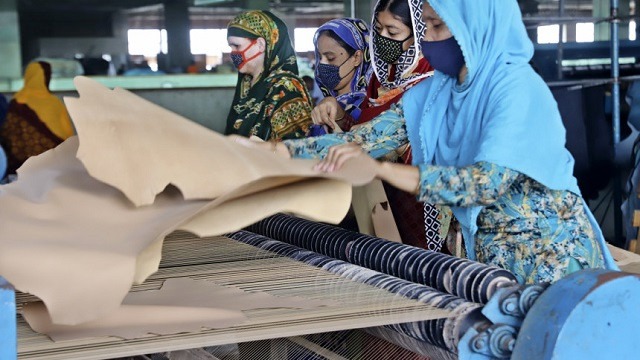
Bangladesh’s leather and footwear
industry ranks as the country’s 2nd-largest export sector after
ready-made garments. The manufacture of leather and related products provides employment
to approximately 2.04 lakh individuals [1] and accounts for about 2.37 percent [2] of the country’s total export earnings as per ITC calculations based on
UN COMTRADE and ITC statistics 2024, while contributing nearly 1.96 percent to
the country’s GDP. [3] The Industry Policy 2022 made this sector a priority, and Bangladesh is
becoming a global sourcing hub because it has a cost-competitive workforce,
access to raw materials, and policy incentives. [4]
The leather goods market was expected
to rise USD 855.36 billion by 2032, with a compound annual growth rate (CAGR)
of 7.05% . [5]
Based on the data from Export
Promotion Bureau (EPB), Bangladesh's
total leather exports for FY2024–25 were USD 1.14 billion, which is a 10.19%
rise from the previous year. However, this performance remains significantly
below the targets outlined in the Leather and Leather Goods Development Policy
2019, which aimed to raise export earnings of the sector to USD 5 billion by
2024, with an anticipated contribution of 1 percent to the national GDP. This
clear gap between the projected
potential and its realized performance. [6]
Furthermore, Bangladesh’s leather
footwear export experienced robust growth, expanding by 23.54%. Over the past
decades, the consistent upward trend has positioned the country among the
world’s top ten footwear producers, as cited in the World Footwear 2024
Yearbook. [7]
Bangladesh’s leather and leather goods
exports are distributed across key markets, including the USA, China, India, France, Germany, Italy,
Japan, Korea, Hongkong, the UK, etc. Despite
this wide market reach, global buyers remain cautious, as Bangladesh continues
to lag in meeting critical compliance standards, particularly concerning waste
management and effluent treatment .
Environmental Compliance
Sustainability in the leather industry
means environmental stewardship. The tanning process involves hazardous
chemicals like chromium which if not managed properly may pollute the water.220
tanneries were relocated to Savar Tannery Estate in 2017 when Central Effluent
Treatment Plant (CETP) was not fully operational and solid waste management
system was not in place. Industry insiders pointed out that technical and
managerial weakness, excessive pollution load than capacity, financial constraint,
no pre-treatment at tannery level, and inefficiency in solid waste management
could cause significant challenge in environmental compliance. [8]
Compliance with international quality
standards is also critical for market competitiveness. Industry insider addressed,
access to key export markets, particularly in the EU and US, requires
certifications such as ISO 14001 and the Leather Working Group (LWG)
standard. However, only 8 Bangladeshi
companies—hold LWG certification. Waste management which is related to CETP
alone contributes 300 of the 1,710 points in the LWG audit. The absence of LWG
certification restricts access to high-value markets, leaving Bangladesh to
compete in low-margin segments while rivals like Vietnam and India dominate
premium categories. [9]
Social Compliance
In addition to environmental
compliance, social compliance constitutes a critical concern for the leather
industry. For instance, workers often lack awareness of their entitled leave
provisions, while many employers deny workers’ sick leave. Similarly, a segment
of female workers remains unaware of their rights to maternity leave, and
employers frequently refrain from granting such benefits in accordance with the
Bangladesh Labor Act (BLA), 2006. (Mia, Sarker, & Islam, 2022). [10]
A study (2024) reported that 84.2% of
tannery workers in Bangladesh suffer from health issues attributable to their
occupational environment. [11] More than half of workers make less than the industry minimum wage of Tk
13,500, and a sizable portion do not have official employment contracts, per a
survey (2022) by the Bangladesh Labor Foundation (BLF) and RAPID. Employees who
work in hazardous environments are susceptible to headaches, respiratory
problems, stomach disorders, and skin diseases. [12] The significance of implementing and upholding labor standards is highlighted
by the fact that some buyers demand certification such as Business Social
Compliance Initiative (BSCI), which encourages moral behavior and better
working conditions across supply chains.
Quality Standards
BSTI introduces certification for
three leather goods products including Direct Molded Sole (DMS) Boots for
General Purpose, Leather Footwear (Physical), and Sole Leather (Vegetable
Tanned).This national certification body mandates that manufacturers adhere to
the BDS requirements for exporting these goods.International markets like the
USA, EU, and others have more stringent
or different compliance requirements, which presents an extra layer of
difficulty for Bangladeshi exporters. For exporters looking to maintain their
competitiveness in the global leather market, this compliance burden poses a
serious quality standard challenge.
For Bangladeshi leather exporters,
non-tariff compliance requirements pose a significant obstacle that imposes
operational and financial strains. The Global Recycled Standard (GRS), one of
these certifications, is crucial because it confirms recycled content and
guarantees ethical material handling across the supply chain. Exporters need to
get certifications like an Environmental Clearance Certificate, a Certificate
of Origin, and LFMEAB membership certification in order to enter the US market.
Compliance requirements differ by buyer, with some requiring audits conducted
from other organizations or from Société Générale de Surveillance (SGS)
Bangladesh Limited or Nirapon.
Institutional and Policy Challenges
Bangladesh’s leather sector is facing
institutional and policy challenges, including low wages (approximately 15000
taka per month) and working environment which discourage skilled graduates from
joining. Experts pointed out that industry, academia, and government
cooperation centered on innovation and practical skills is lacking.
Furthermore, regulatory barriers,
inefficiencies in customs lead to delays and increased shipment costs,
highlighting the urgent need for reforms to improve competitiveness.
Additionally, the factories and tanneries lack a consistent monitoring system to stop labor rights violations. These policy inconsistencies, which go against these policies or acts (Leather and Leather Development Policy 2019, Industrial Policy 2022, Bangladesh Labour Act, 2006, etc.), affect the sector's long-term trajectory and discourage investment. [13]
Pathways for Improvement
A multi-dimensional strategy may be
required to overcome these challenges:
1.
Implement cleaner production
technologies in tanneries to minimize hazardous discharges.
2.
Upgrade CETP infrastructure and
introduce pre-treatment systems to improve waste management and regulatory
compliance.
3.
Ensure labor compliance and
occupational safety through monitoring, wage enforcement, contracts, protective
equipment, and training
4.
Conduct worker awareness and
capacity-building programs on rights, leave, and safe chemical handling
5.
Align tanneries with LWG certification
and international standards for traceability, chemical management, and
sustainability.
The leather industry of Bangladesh currently stands at a critical juncture, facing pivotal challenges and opportunities that will shape its future trajectory. While the economic value and global competitiveness is huge, compliance issues – environmental, social and quality – are holding back growth. The leather industry may undergo positive changes as a result of market diversification, policy stability, workforce development, and infrastructure investment. With strategic interventions and coordinated efforts from government agencies, private sector and international partners, Bangladesh may turn its leather sector into a sustainable, high value and globally competitive industry.
[7] World Footwear. (2025, June 20). Bangladesh: Leather and non-leather footwear exports on the rise in 2024–2025. Retrieved from https://www.worldfootwear.com/news/bangladesh-leather-and-non-leather-footwear-exports-on-the-rise-in-2024-2025/10737.html
[8] Bangladesh Small and Cottage Industries Corporation. (2024). [Annual Report of BSCIC 2023-24]; Retrieved from https://bscic.gov.bd/site/page/f4a70281-2052-42ba-b77e-8070182ed7b4/-#
[9] Chowdhury
Farjana, Y., & Hawlader, M. R. (2024). Sustainable growth strategies for
Bangladesh's leather industry: Policy recommendations and future perspectives. International
Journal of Business and Management, 19(2), 120.
https://doi.org/10.5539/ijbm.v19n2p120
[10] Mia, M., Sarker, M., & Islam, M. (2022). Labor rights and workplace safety of tannery workers in Bangladesh. Journal of Social Studies and Development, 15(2), 45–60; http://dx.doi.org/10.31841/KJEMS.2022.111;
[11] Oyshi, N. M., Al Rafi, A., & Karami, M. J. H. (2024, July). Identifying factors associated with health problems of tannery workers, Savar, Dhaka. Dhaka University Journal of Science, 72(2), 68–74. https://doi.org/10.3329/dujs.v72i2.75473
[12] Bangladesh Labour Foundation (BLF) and The Research and Policy Integration for Development Society (RAPID) (2022). Employment and working conditions in Bangladesh’s leather industry. https://togetherfordecentleather.org/wp-content/uploads/2022/09/Report-Conditions-in-Bangladeshs-leather-industry-final.pdf
[13] Moazzem, K. G., Khandker, A., & Ahmed, T. (2022). Sustainability challenges in Bangladesh’s leather industry. Journal of Development Studies, 48(3), 55–72. http://dx.doi.org/10.13140/RG.2.2.25311.27041



-medium.jpg)