


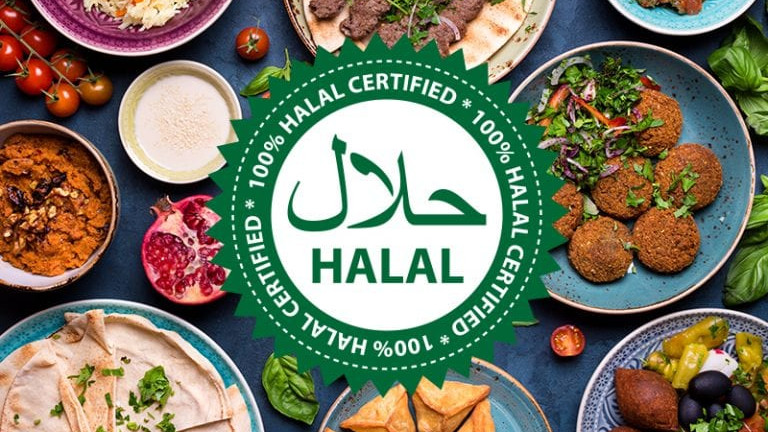
Bangladesh has significant potential to tap into the growing global halal food market as a Muslim-majority country with a robust agricultural sector and familiarity with halal consumption. The halal food market is forecasted to grow from US$ 2.71 trillion in 2024 to US$ 5.91 trillion by 2033, driven by a rising demand for halal-certified products among Muslims and non-Muslims, and increased focus on food safety and ethical consumption. [1]
In Arabic, halal means ‘lawful’ or ‘permitted’ under Islamic teachings. In the context of food, halal refers to items that comply with Islamic dietary laws. [2] While many foods like fruits, vegetables and grains are inherently halal, meat must come from selected animals (e.g., cattle, camels and poultry) that are treated humanely and slaughtered in the name of Allah according to Islamic guidelines (zabiha), by cutting across the animal’s throat to ensure swift drainage of blood. [3] The opposite of halal is ‘haram’ (forbidden), which includes prohibited items like pork, insects, reptiles, carnivores, and alcohol. [4] Fish fed with pork or impure animal derivatives are also considered haram. [5]
While the global halal industry spans many sectors including food, pharmaceuticals, finance, tourism, cosmetics, fashion, etc., Bangladesh is particularly well-positioned to expand its halal food exports, thanks to its diversified agriculture, well-established livestock and dairy industries, fertile land, extensive river networks, and cost-competitive labor.
Market size of halal food
The global halal food market is thriving. OIC (Organisation of Islamic Cooperation) members imported US$293.6 billion in halal food in 2023, projected to reach USD 442.3 billion by 2028 at 8.5% annual growth.[6] Indonesia’s annual halal food expenditure surpassed $159 billion in 2023. Europe’s halal food market is worth approximately $66 billion. [7] France leads the market, accounting for around $17 billion. In the United States, Muslims spend around $13 billion on halal food each year.
Performance of global market players
The top buyers of halal food from OIC are Saudi Arabia, Indonesia, Turkey, Malaysia, the United Arab Emirates (UAE), Egypt, Iran, Iraq, Algeria and Morocco. [8] The top suppliers to OIC markets are Brazil, India, Russia, USA, Turkey, UAE, China, Indonesia, Australia and Argentina. Notably, Indonesia is the largest national market by expenditure on halal food, followed by Bangladesh and Egypt. Top halal food items exported to OIC countries are cereals (21.22%), animal and vegetable oils (10.07%), sugar (7.07%), followed by oil-seeds and oleaginous fruits (6.51%), dairy and animal products (6.25%), and industrial residues and animal feed (5.89%).

In Brazil, halal certification is provided by FAMBRAS Halal, which functions under FAMBRAS (The Federation of Muslim Associations in Brazil). FAMBRAS Halal is accredited by the Gulf Cooperation Council Accreditation Center (GAC), Turkey’s Halal Accreditation Agency (HAK) as well as JAKIM (The Department of Islamic Development Malaysia). [9] Other certifiers in Brazil include the Latin American Islamic Information Center (CDIAL Halal) and the Islamic Inspection Service (SIILHalal). [10]
India has several halal certification bodies for businesses, including the Jamiat Ulama-i-Hind Halal Trust. For halal meat and meat products, Indian exporters can export to 15 designated countries, including Bangladesh, only after obtaining certification under the “India Conformity Assessment Scheme (I-CAS)-Halal” of the “Quality Council of India (QCI)” . [11] After shipment, exporters must share their I-CAS Halal certificates with buyers, which are issued by certification bodies accredited by the National Accreditation Board for Certification Bodies (NABCB). Additionally, exporters must comply with the importing country’s halal regulations and, where applicable, obtain certificates approved by the authorities of the importing country.
Although halal-certified food is consumed principally by Muslims, Muslim-majority countries are lagging behind in their exports. However, several Muslim countries like Malaysia [12] and Indonesia [13] have taken initiatives to capture the global halal market by establishing internationally recognized halal accreditation and certification bodies, offering financial incentives to halal product exporters, enforcing strict compliance with halal standards, etc. Notably, Malaysia’s JAKIM and Indonesia’s Halal Product Assurance Organizing Agency (BPJPH) not only certify local businesses but also accredit foreign halal certifying authorities. For example, JAKIM has accredited Bangladesh’s Islamic Foundation. [14]
Turkey, the only Muslim-majority country among the top 10 exporters of halal food, established HAK to accredit Turkish and foreign halal certification bodies, in line with the standards of SMIIC (The Standards and Metrology Institute for Islamic Countries).[15] SMIIC aims to achieve harmonization and mutual recognition of standards between OIC (Organisation of Islamic Cooperation) countries to facilitate trade among them. [16]
Current state of Bangladesh’s halal exports
Data on Bangladesh’s halal food exports is currently not available from any institutional framework. As of November 2021, Islamic Foundation has certified around 254 companies including packaged food, meat, fish, cosmetics, pharmaceutical and chemical companies. [17] , while BSTI (Bangladesh Standards & Testing Institution) had certified 9 companies as of August,2023, including food, pharmaceutical and chemical companies. [18] Bangladeshi companies exported halal goods worth $843.03 million in FY 2022-23, mostly to Muslim countries. [19]
Bangladesh’s leading food exports include fish and seafood; cereal and milk-based products (such as bread, pasta, and starch); fats and oils derived from animals, plants, and microbes; fruits and nuts; spices and tea; and, vegetables, roots and tubers. [20] These five categories represent around 83% of the country’s food export. The primary markets for these items are India, EU, China, UK, Saudi Arabia, USA, and Japan.

- Malaysia: Spices and tea; cereal and milk-based products; vegetables, roots and tubers; fish and seafood; and, oil seeds and oleaginous fruits
- Turkey: Fish and seafood; miscellaneous edible preparations (e.g., sauces, ice cream and soups); preparations of meat, fish and seafood; oil seeds and oleaginous fruits
[2]Halal Research Council. (2025, September 16). Guide to Understanding Halal Foods. Retrieved from Halal Research Council: https://www.halalrc.org/images/Research%20Material/Literature/Guide%20to%20Halal%20Foods.pdf
[3] Halal Food Council USA. (2025, September 16). Halal vs. Zabiha: What is
difference in it? Retrieved from Halal Food Council USA:
https://halalfoodcouncilusa.com/halal-vs-zabiha-what-is-difference-in-it/
[4] Halal Monitoring Authority. (2025, September 16). What is Halal?
Retrieved from Halal Monitoring Authority:
https://hmacanada.org/what-is-halal/?
[5] Islamic Services of America. (2021, December 9). Halal Seafood.
Retrieved from https://isahalal.com/news-events/blog/halal-seafood:
https://isahalal.com/news-events/blog/halal-seafood
[6]DinarStandard. (2025). State of the Global Islamic Economy (SGIE) 2024/25.
New York City: DinarStandard.
[7] Zulfikaroglu, Y. (2023) Developing Export Competitiveness of Potential Halal Products of Bangladesh.
[8] Dinar Standard. (2025). State of the Global Islamic Economy (SGIE) 2024/25.
New York City: DinarStandard.
[9]FAMBRAS Halal. (2025, September 16). Accreditations and Recognitions.
Retrieved from FAMBRAS Halal: https://www.fambrashalal.com.br/en/acreditacoes
[10] HAK (Halal Accreditation Agency). (2025, September 15). Halal Regulations by Country- Brazil. Retrieved from Halal Acredition Agency(HAK): https://english.hak.gov.tr/international-relations/halal-regulations-by-country/americas/brazil
[11] Ministry of Commerce & Industry, Government of India. (2024). Streamlining of Halal Certification Process for Meat and Meat Products. New Delhi: Ministry of Commerce & Industry, Government of India.
[12] HDC (Halal Development Corporation Berhad) . (2024, September 18). Malaysia’s Halal Economy: A Journey of Transformative Growth and Global Leadership. Retrieved from Halal Development Corporation Berhad (HDC) : https://hdcglobal.com/news/2024/09/18/malaysias-halal-economy-a-journey-of-transformative-growth-and-global-leadership/
[13]Law of the Republic of Indonesia. (2014). Halal Product Assurance.
Retrieved from CMSBL:
https://cmsbl.halal.go.id/uploads/Law_33_2014_on_Halal_Product_Assurance_8c328febdf.pdf
[14]JAKIM (Department of Islamic Develpment Malaysia). (2024, May 20). The Recognized Foreign Halal Certification Bodies & Authorities. Retrieved from Department of Islamic Develpment Malaysia (JAKIM): https://myehalal.halal.gov.my/portal-halal/v1/pdf/cb/CBLIST-20May2024.pdf
[15]HAK (Halal Accreditation Agency). (2025). History. Retrieved from Halal
Accreditation Agency (HAK): https://english.hak.gov.tr/about-us/history
[16] SMIIC (The Standards and Metrology Institute for Islamic Countries. (2025.). SMIIC. Retrieved from The Standards and Metrology Institute for Islamic Countries (SMIIC), : https://www.smiic.org/en/smiic
[17]Islamic Foundation. (2025). List of Certified Companies. Dhaka: Islamic
Foundation. Retrieved from
https://islamicfoundation.gov.bd/sites/default/files/files/islamicfoundation.portal.gov.bd/files/58300b78_bb78_452d_b729_4c061b275794/2025-06-19-07-07-78d045e028576938d4945d8fdd8abc4d.pdf
[18]BSTI. (2023, December). List of Halal Certified Client . Retrieved from
BSTI:
https://bsti.portal.gov.bd/sites/default/files/files/bsti.portal.gov.bd/page/b23520a9_a3c4_4f48_be36_c3ee53089f8b/2024-01-17-08-53-898eab53a83d50f71af4931c5e7b8527.pdf
[19]BRCP-1. (2025, February 10). Request for Expression of Interest for
selection of a consulting firm (National) for Conducting feasibly study.
Retrieved from Ministry of Commerce:
http://brcp-1.gov.bd/wp-content/uploads/2025/02/SD_53-TOR-for-Conducting-feasibly-study-on-halal-product-export-for-Bangladesh-suggested-by-WTO-Wing-Ministry-of-Commearce.pdf
[20] ITC (International Trade Centre). (2025, September 15). List of products at 2 digits level exported by Bangladesh in 2024 (Mirror). Retrieved from ITC Trade Map:https://www.trademap.org/Product_SelProductCountry.aspxnvpm=1%7c050%7c%7c%7c%7cTOTAL%7c%7c%7c2%7c1%7c2%7c2%7c1%7c1%7c1%7c1%7c1%7c1
[21]Islamic Foundation. (2023, November 21). Bangladesh Gazette. Halal
Certification Policy 2023. Dhaka, Bangladesh:
https://islamicfoundation.gov.bd/sites/default/files/files/islamicfoundation.portal.gov.bd/files/58300b78_bb78_452d_b729_4c061b275794/2023-12-10-09-58-2faec72f8a731267328f901698dd356a.pdf.
[22]Arabian Gulf Business Insight. (2025, July 17). Growing demand for halal
meat forces shifts in global supply. Retrieved from Arabian Gulf Business
Insight:
https://www.agbi.com/analysis/agriculture/2025/07/growing-demand-for-halal-meat-forces-shifts-in-global-supply/?utm_source=chatgpt.com
[23]Verbeke, W., Rutsaert, P., Bonne, K., & Vermeir, I. (2013). Credence
quality coordination and consumers' willingness-to-pay for certified halal
labelled meat. Meat Science, 790-797.
[24]BFTI (Bangladesh Foreign Trade Institute). (2019, November 20). Removing
barriers to meat export. Dhaka: BFTI.
[25]BBS. (2024, October 1). Livetsock, Forestry and Fisheries. Retrieved from BBS: http://nsds.bbs.gov.bd/en/posts/192/LIVESTOCK,%20FORESTRY%20AND%20FISHERIES
[26]Haider, N., Khan, S. U., Islam, A., Osmani, M. G., Rahman , M. Z., Epstein, J.
H., . . . Zeidner , N. S. (2017). Efficiency of the Clinical Veterinary
Diagnostic Practices and Drug Choices for Infectious Diseases in Livestock in
Bangladesh. Transbou. PubMed, 1329–1333.
[27] BIDS. (2016). Barriers to Development of Livestock Sub-sector in Bangladesh. Dhaka: BIDS.
[28]Bangladesh Bank. (2024, June 30). ২০২৪-২৫
অর্থবছরে রপ্তানির বিপরীতে রপ্তানি প্রণোদনা /নগদ সহায়তা
দান।. Retrieved from
Bangladesh: https://www.bb.org.bd/mediaroom/circulars/fepd/jun302024fepd12.pdf
[29] BARC (Bangladesh Agricultural Research Council) . (2023). Bangladesh Livestock Research Priorities. Dhaka: BARC
[30] DLS (Department of Livestock Services). (2022). Livestock & Dairy Business Structure Analysis Report for Bangladesh. Dhaka: DLS.



-medium.jpg)